

Managing payroll in India is about far more than calculating salaries. Every employer must adhere to a layered framework of statutory obligations — Provident Fund (PF), Employee State Insurance (ESI), Tax Deducted at Source (TDS), Professional Tax (PT), and Labour Welfare Fund (LWF) — each with its own rates, deadlines, filing formats, and state-specific variations. Fortunately, payroll automation is transforming how businesses manage this complexity entirely.
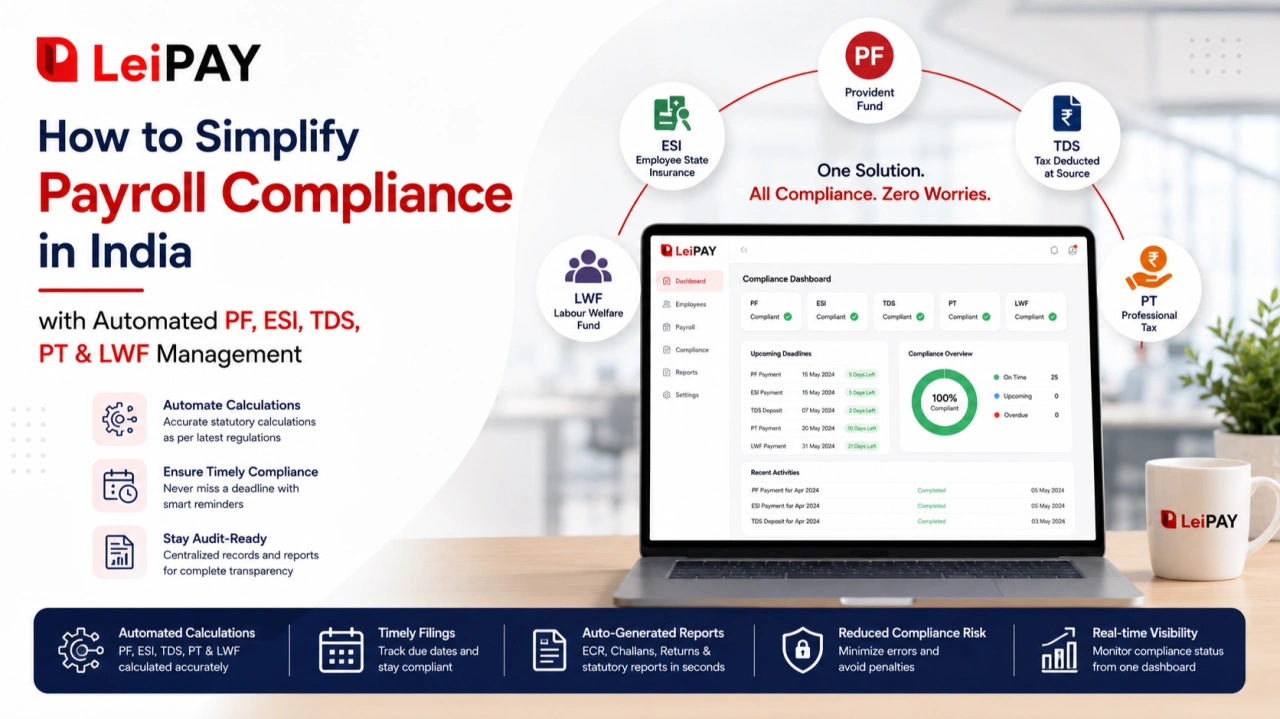
One Solution. All Compliance. Zero Worries.
The Growing Complexity of Payroll Compliance
Indian payroll regulations require organisations to stay updated with frequent changes in tax laws, contribution rates, filing procedures, and reporting requirements. What worked two years ago may be non-compliant today — ESI thresholds revised, PT slabs updated by state, TDS regime options changed, new Labour Code timelines introduced.
The most common compliance challenges HR and finance teams face:
- Manual calculation errors — wrong PF wage ceiling, incorrect ESI applicability
- Missed statutory deadlines — PF by 15th, ESI by 21st, TDS by 7th, Form 24Q quarterly
- Managing multiple compliance records across states and employees
- Preparing government reports and filings in prescribed formats
- Ensuring audit readiness — complete documentation available on demand
Understanding Each Statutory Component
Provident Fund
PF requires employers to calculate employee and employer contributions accurately every month — employee 12% of basic, employer 13% (12% PF + 1% admin charges). Monthly ECR file generated for upload to EPFO Unified Portal. UAN numbers maintained for every employee. Annual PF return filed.
Employee State Insurance
ESI applies to employees earning up to the prescribed wage ceiling. Employee contribution 0.75%, employer contribution 3.25%. Half-yearly ESI returns filed. Accurate applicability determination critical — employees above threshold must be excluded correctly when wages change.
Tax Deducted at Source
TDS under Section 192 requires employers to deduct the correct tax from salary monthly — based on each employee's income, declared investments, and choice of old or new tax regime. Quarterly Form 24Q filed via TRACES portal. Form 16 issued annually.
Professional Tax
Professional Tax rates vary by state — Tamil Nadu, Karnataka, Maharashtra, Telangana, Andhra Pradesh, West Bengal all have different slabs and filing frequencies. For multi-branch businesses, applying the correct PT slab for each employee's state manually is error-prone and time-consuming.
Labour Welfare Fund
LWF applies in states that have enacted the Labour Welfare Fund Act — contribution rates and frequencies vary. Typically semi-annual — June and December. Organisations operating across multiple states must track which states LWF applies in and ensure timely contributions.
Why Manual Compliance Management Creates Risk
Traditional payroll processes rely on spreadsheets and disconnected systems. Managing five statutory components — each with different rates, deadlines, state variations, and filing formats — manually across a growing workforce creates compounding risk:
Managing PF, ESI, TDS, PT, and LWF manually is not a compliance strategy — it is a compliance risk. Automation converts each obligation from a monthly stress point into a solved, background function.
How Payroll Automation Simplifies All 5 Components
Automated Statutory Calculations
LeiPay's statutory compliance engine automatically calculates PF, ESI, TDS, PT, and LWF from the correct rates every payroll cycle. Rate changes and threshold updates applied automatically — no manual reconfiguration when regulations change.
Compliance Deadline Tracking
Built-in reminders sent before each filing deadline — PF 15th, ESI 21st, TDS 7th, Form 24Q quarterly due dates. HR and finance teams are alerted in advance — never surprised by a missed deadline. The compliance calendar is always current.
Auto-Generated Reports and Filings
All compliance reports generated automatically in the prescribed format — ECR for EPFO, ESI challan for ESIC portal, Form 24Q in NSDL FVU format for TRACES, PT returns for state portals. Direct portal upload ready. No manual formatting or data extraction required.
Centralised Compliance Records
All payroll and compliance documents maintained digitally in one place — with version history, filing confirmation, and challan records. Accessible instantly for audits, inspections, or management review through LeiPay's compliance dashboard.
Real-Time Compliance Visibility
Live compliance status dashboard — PF: Compliant, ESI: Compliant, TDS: Compliant, PT: Compliant, LWF: Compliant — visible at all times. Upcoming deadlines and risk alerts surfaced automatically so leadership knows the compliance posture without asking HR.
Benefits of Automated Payroll Compliance
How LeiPay Helps Businesses Stay Compliant — All 5 Components, One Platform
LeiPay's payroll compliance software is designed to simplify statutory compliance for organisations of all sizes. With automated PF, ESI, TDS, PT, and LWF management, LeiPay helps businesses:
- Automate payroll calculations across all statutory components
- Generate statutory reports instantly — ECR, Form 24Q, ESI challan, PT returns
- Track compliance deadlines with built-in reminder alerts
- Reduce manual errors through system-enforced rate application
- Stay audit-ready year-round with centralised digital records
By eliminating compliance administration, LeiPay enables HR and finance teams to focus on strategic business initiatives rather than statutory paperwork.
Also read: How Payroll Compliance Software Reduces Business Risk | Old vs New Tax Regime India 2026 — Which Should Your Employees Choose?
Simpler Compliance. Lower Risk. Stronger Growth.
Payroll compliance is essential for every Indian organisation — but it does not have to be complicated or time-consuming. By automating PF, ESI, TDS, PT, and LWF management, businesses can minimise compliance risk, improve operational efficiency, and ensure timely statutory filings every month.
As regulations continue to evolve, payroll automation is becoming a necessity rather than an option. Organisations that embrace automated compliance solutions today will be better positioned for sustainable growth tomorrow.
Explore LeiPay's compliance features in detail, or view pricing — plans built for Indian businesses of every size.