

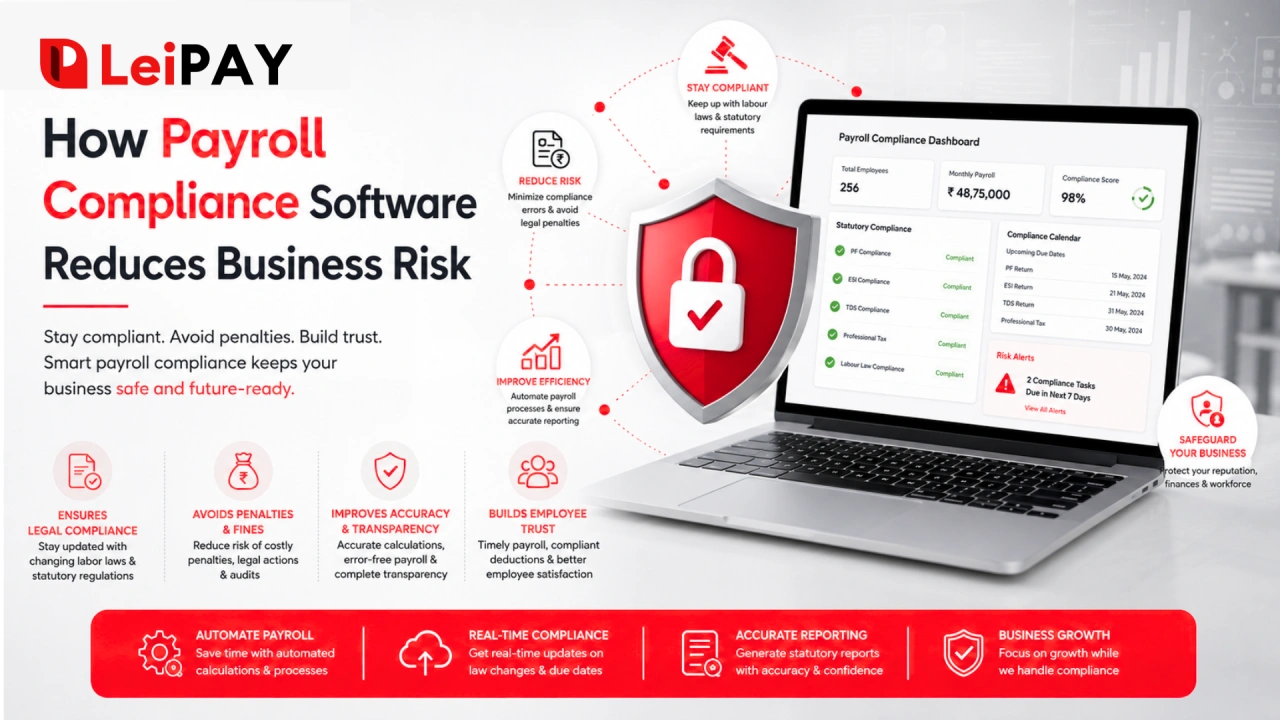
Payroll compliance is not a back-office concern — it is a business risk. In India, where statutory obligations span PF, ESI, TDS, Professional Tax, Labour Welfare Fund, and quarterly TDS returns, a single missed deadline or incorrect calculation can trigger penalties, legal notices, and regulatory scrutiny. The right payroll compliance software converts this risk into a solved, automated function.
Understanding Payroll Compliance in India
Payroll compliance in India refers to the full range of statutory obligations that every employer must meet — accurate computation of contributions, timely filing of returns, correct issue of certificates, and maintenance of records. Non-compliance does not just result in fines — it creates a regulatory history that affects business credibility, attracts audit attention, and in serious cases, results in legal action against the company and its directors.
The statutory components every Indian employer must handle:
- Provident Fund (PF) — employee 12%, employer 13% (12% + 1% admin), monthly challan, UAN management
- ESI — employee 0.75%, employer 3.25% for applicable salary range, half-yearly returns
- TDS under Section 192 — monthly deduction, quarterly old and new regime computation, Form 24Q filing
- Professional Tax — state-specific slabs, monthly or annual payment depending on state
- Labour Welfare Fund — state-specific, semi-annual contribution
- Annual filings — Form 16/16A, Form 24Q Q4, PF annual return, ESI annual return
Each component has its own rate structure, applicability threshold, filing deadline, and return format. Managing these manually across a growing workforce — and across multiple states — is where compliance breaks down.
The Risks of Manual Payroll Compliance Management
Most payroll compliance failures in Indian businesses are not caused by intentional non-compliance — they are caused by systems that cannot keep up with complexity. Here are the five most common compliance risks that manual payroll creates:
Human Errors
Incorrect PF wage ceiling applied, ESI threshold not updated, wrong PT slab for a state — these calculation errors appear minor individually but create significant cumulative exposure. Risk: Government notices and interest charges.
Compliance Violations from Missed Deadlines
PF challan due by the 15th. ESI by the 21st. TDS by the 7th. Form 24Q quarterly. Each missed deadline triggers Section 234E penalties — ₹200 per day until filed. Risk: Compounding penalties that cost thousands per month.
Data Security Risks
Payroll data stored in spreadsheets — salary, PAN, bank account, UAN — is sensitive personal financial data. Without access controls, this data is visible to anyone with the file. Risk: Data protection violations and internal fraud.
Lack of Audit Readiness
When payroll records are scattered across spreadsheet versions, email threads, and physical files, producing complete documentation during an audit becomes a crisis. Risk: Inability to demonstrate compliance during inspection.
Operational Delays
Manual compliance tracking delays payroll processing — waiting for compliance figures before salary can be processed. This cascades into delayed salaries and employee dissatisfaction. Risk: Attrition from a compliance bottleneck.
How Payroll Compliance Software Reduces These Risks
Purpose-built payroll compliance software does not just automate calculations — it eliminates the structural conditions that allow compliance failures to occur. Here is how:
Automated Compliance Management
PF, ESI, TDS, PT, and LWF computed automatically from the correct rates every payroll cycle. Rate changes and threshold updates applied without manual reconfiguration.
LeiPay's statutory compliance engine manages all components — including Form 24Q quarterly TDS returns in NSDL FVU format for direct TRACES portal upload.
Accurate Payroll Processing
Connected attendance and leave data flows directly into salary computation — no manual transfer, no reconciliation gaps that create incorrect statutory bases.
Salary revisions, promotions, and exits are handled through employee lifecycle management — compliance recalculated automatically with each change.
Real-Time Compliance Reporting
Compliance status visible in real time — what is filed, what is pending, what is due in the next 7 days. Payroll compliance dashboards give finance and HR leadership the visibility to act before deadlines, not after penalties.
Improved Data Security
Salary data, PAN numbers, UAN records, and bank details protected through role-based access control — each role sees only what it needs. AES-256 encryption at rest. Every access event logged in a tamper-proof audit trail.
Audit-Ready Records
Every payroll cycle, every statutory payment, every form filed — maintained digitally in a centralised system with version history. During an audit or inspection, any record is retrievable instantly without manual assembly.
Multi-level approval workflows create an additional layer of governance — salary changes, deduction modifications, and payroll runs all approved and logged before execution.
Better Workforce Transparency
Employees see every statutory deduction explained in their payslip — PF, ESI, TDS, PT broken down clearly. Investment declarations, Form 16, and tax certificates accessible through the self-service portal. Compliance becomes a trust-builder, not a source of queries.
Payroll compliance is not a once-a-month task — it is a continuous obligation that changes every year. The businesses that manage it best are the ones that stopped managing it manually.
Why Payroll Compliance Matters More Than Ever in 2026
India's regulatory environment continues to evolve — new Labour Codes, updated ESI thresholds, TDS regime changes, and quarterly filing obligations are not going to simplify. Businesses that invested in compliance infrastructure early are operating with confidence. Those still managing it manually are accumulating risk with every payroll cycle.
How LeiPay Simplifies Payroll Compliance
LeiPay handles the full Indian compliance framework natively — PF, ESI, TDS, PT, LWF, Form 24Q, Form 16, ECR files, ESI challans, and PT returns — all generated automatically from payroll data. No manual computation. No separate compliance tool needed.
The Future of Payroll Is Automated
Payroll is no longer a back-office admin task — it is a strategic business function. The organisations getting it right are using payroll compliance software that updates automatically, generates returns on schedule, and gives leadership real-time visibility into their compliance posture.
Also read: 7 Payroll Errors That Quietly Drain Indian Businesses | Turn Payroll Problems into Productivity with LeiPay
Smarter Compliance. Lower Risk. Stronger Business.
Payroll compliance risk is manageable — with the right system. LeiPay's payroll compliance software eliminates manual statutory management, keeps every filing on time, and gives your business the audit-ready records it needs to operate with confidence.
Explore all LeiPay features or view pricing plans built for Indian businesses of every size.