

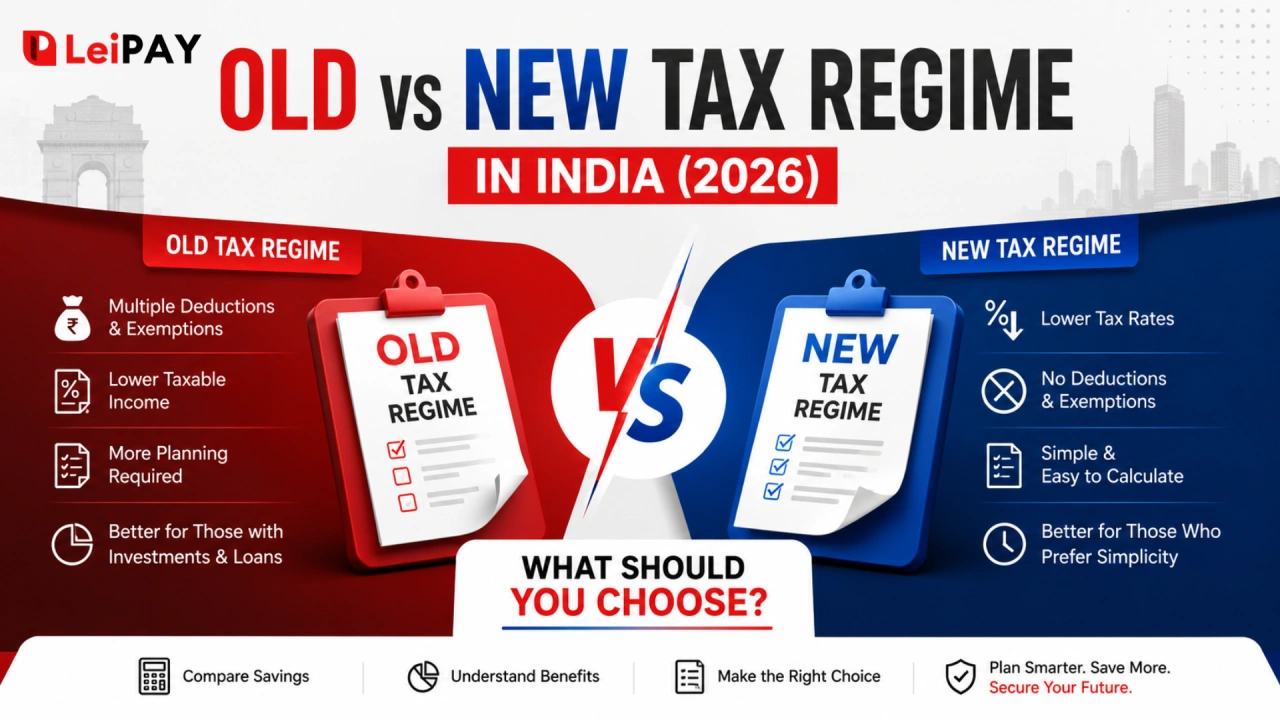
The choice between the old and new tax regime is now the most consequential payroll decision Indian employees make every financial year. Get it right and they optimise their take-home pay. Get it wrong and they overpay tax — or face a large liability at year end. As an employer, your payroll system must support both regimes accurately and switch between them seamlessly.
- Multiple deductions — 80C, 80D, HRA, LTA
- Lower taxable income through exemptions
- Ideal for those with investments and loans
- More planning and documentation required
- Higher base tax rates
- Lower flat tax rates across all slabs
- Simple calculation — no proofs needed
- Ideal for those with minimal investments
- No deductions or exemptions allowed
- Less flexibility for high-investment employees
Understanding the Old Tax Regime
The old tax regime is India's traditional income tax system — the one that allows employees to significantly reduce their taxable income through deductions and exemptions accumulated across investments, loans, and qualifying expenses.
Key deductions available under the old regime:
- Section 80C — up to ₹1.5 lakh on PF, PPF, ELSS, life insurance, home loan principal, NSC
- Section 80D — medical insurance premiums for self, spouse, children, and parents
- HRA exemption — House Rent Allowance for employees living in rented accommodation
- LTA — Leave Travel Allowance for domestic travel twice in a block of four years
- Home loan interest — up to ₹2 lakh under Section 24(b)
The old regime is particularly beneficial for employees who actively invest in tax-saving instruments, pay significant rent or home loan EMIs, or have dependent parents requiring medical insurance. With proper tax planning, the effective tax rate under the old regime can be substantially lower than it appears at face value.
However, it requires documentation — investment proofs, rent receipts, and insurance certificates must be submitted through the employer's payroll system before year-end. This is exactly what LeiPay's employee self-service portal handles — employees submit Form 12BB declarations and upload proofs digitally, which flow directly into TDS calculation.
Understanding the New Tax Regime
The new tax regime, made the default regime from FY 2023-24, offers significantly lower tax rates across all income slabs — but removes almost all exemptions and deductions. No HRA. No 80C. No LTA. No home loan interest. Just income taxed at the slab rate.
The new regime is ideal for younger employees early in their career who have not yet built significant investments, those with no home loan or HRA claims, and anyone who values simplicity over optimisation. Higher take-home pay every month — at the cost of tax-saving discipline.
There is no universally right answer — the right regime depends entirely on each employee's income, investments, and financial goals. The employer's job is to make both options available and calculate each accurately.
Which Regime Should Your Employees Choose?
Consider Old Regime If:
- Annual 80C investments exceed ₹1.5 lakh
- Paying significant rent — HRA exemption is claimed
- Home loan with interest above ₹1 lakh per year
- Medical insurance premiums for family
- Income above ₹15 lakh with substantial deductions
Consider New Regime If:
- Minimal or no tax-saving investments
- No home loan or rental accommodation
- Prefer higher monthly take-home over year-end planning
- Income below ₹7 lakh (zero tax with rebate)
- Want to avoid investment proof documentation
How LeiPay Handles Both Tax Regimes — For Every Employee
When your workforce has employees on both regimes — some who switched to new, some staying on old, some changing mid-year — manual TDS management becomes unmanageable. LeiPay handles the complexity automatically.
Employee-Level Regime Selection
Each employee selects their preferred tax regime through LeiPay's self-service portal. The system applies the correct slab rates, exemptions, and deductions immediately — TDS is recalculated from the moment the selection is confirmed. No manual reconfiguration by HR required.
Form 12BB — Digital Declaration
For employees on the old regime, investment declarations are submitted digitally through the portal — 80C instruments, HRA rent receipts, insurance certificates, home loan interest certificates. LeiPay's TDS engine incorporates each declaration into the monthly TDS computation automatically.
Form 24Q and Form 16 — Both Regimes Covered
Quarterly Form 24Q is generated covering all employees — each with their correct regime, deductions, and TDS amounts. At year end, Form 16 Part B reflects the correct regime for each employee — old or new — with the accurate computation. No manual regime-wise segregation by HR.
Regime Comparison for Employees
LeiPay enables employees to compare their tax liability under both regimes based on their actual salary and declared investments — so they can make an informed decision rather than guessing. This directly reduces the number of mid-year regime change requests that create payroll reprocessing work.
Also read: 5 Payroll Mistakes Every Growing Business Makes — and how automated TDS handling prevents one of the most common ones.
The Right Regime — Supported by the Right System
As India's tax landscape continues to evolve in 2026, the old vs new regime decision will remain a recurring question for every employer and employee. The answer will be different for every individual in your workforce — and your payroll system needs to handle all of them accurately, simultaneously.
LeiPay supports both regimes natively — no workarounds, no manual overrides, no year-end surprises. Employees choose. The system calculates. TDS is correct. Form 16 is ready. That is how modern payroll handles tax regime complexity.