

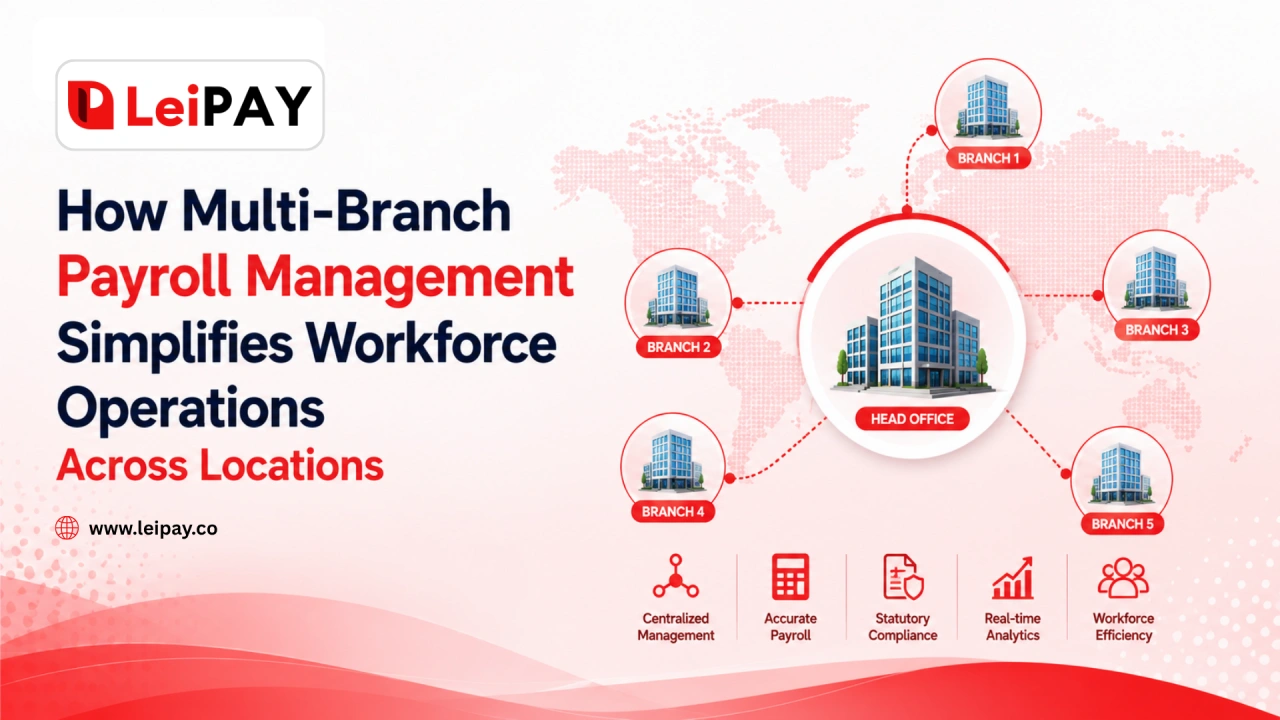
As businesses expand across cities, states, and regions, workforce management grows exponentially more complex. Multiple attendance systems, varying state-specific compliance rules, decentralised salary processing, and limited visibility into branch-level payroll costs — these challenges compound with every new location added. Multi-branch payroll management solves this by centralising operations without sacrificing branch-level control.
The Challenges of Managing Payroll Across Multiple Branches
Organisations with branches across Tamil Nadu, Karnataka, Maharashtra, and other states face a unique payroll problem: each location has its own Professional Tax slabs, attendance patterns, shift structures, and compliance requirements. Managing these independently at each branch creates four critical failure points:
Inconsistent Payroll Processes
Different branches use different methods — some on spreadsheets, some on software, some manual. The result: salary errors that take weeks to reconcile.
Attendance and Leave Gaps
When branch attendance data is manually transferred to payroll, errors accumulate at every handoff — wrong LOP, missed overtime, incorrect shift calculations.
Compliance Risk at Branch Level
State-specific Professional Tax, ESI applicability, and LWF contributions differ by location. Manual management creates the risk of wrong rates applied silently — until an audit reveals the gap.
No Central Workforce Visibility
HQ leadership cannot see real-time headcount, payroll cost, attendance trends, or compliance status across branches — making data-driven decisions impossible without waiting for monthly reports.
One platform. Multiple branches. Complete payroll control. That is the standard Indian businesses are moving towards — and what multi-branch payroll management delivers.
Why Multi-Branch Payroll Management Matters
A centralised payroll platform does not mean uniform payroll — it means consistent processes applied correctly across every branch. HR teams at head office can configure branch-specific rules, while branch managers see only their team's data. Payroll runs accurately for every location — without branch-level manual intervention.
This structure creates three compounding benefits:
- Greater operational control — head office sees everything, branches manage their own teams
- Reduced administrative complexity — one system handles all locations instead of separate tools per branch
- Audit-ready compliance — all statutory records maintained centrally, retrievable instantly for any branch
6 Key Benefits of Multi-Branch Payroll Management
Centralised Payroll Processing Across All Branches
A unified payroll platform processes salary for every branch from a single dashboard. HR teams manage salary calculations, deductions, reimbursements, and payroll approval workflows without switching between systems or chasing branch-level data.
For businesses with 5 branches or 50, the payroll cycle runs the same way — configured once at the centre, applied consistently everywhere.
Consistent Salary Policies Across Every Location
Standardised salary structures, leave policies, and shift configurations apply uniformly across branches — while branch-specific overrides (different shift timings, local holidays, varying allowances) remain configurable at the branch level. Consistency where it matters, flexibility where it is needed.
Also read: LeiPay Leads the Way — Smarter Attendance, Smarter Pay — how attendance integration removes the manual step between branches and payroll.
Integrated Attendance From Every Branch
Branch attendance data — whether captured through biometric devices, mobile app check-ins, or geo-fencing for field teams — flows directly into the centralised payroll engine. No manual data transfer between branches and HR. No reconciliation errors.
For businesses with manufacturing plants, retail outlets, field sales teams, or construction sites across multiple locations, this integration eliminates the single biggest source of payroll errors.
State-Specific Compliance — Applied Automatically
Statutory compliance in a multi-branch business is not uniform — Professional Tax slabs differ by state, LWF applicability varies, and ESI contribution thresholds need to be applied correctly per location. Managing these manually across branches is error-prone.
LeiPay applies the correct state-specific PT slab, LWF rate, and ESI applicability automatically for each branch — without requiring separate configuration for every location change. Form 24Q, ECR files, and PT returns are generated per branch, ready for portal upload.
Real-Time Workforce Visibility Across All Locations
Payroll reports and analytics give management a real-time view of salary costs, headcount, attendance trends, overtime, and compliance status — by branch, by department, or consolidated across the organisation.
Branch managers see their own team's data. Regional heads see their cluster. HQ leadership sees everything. Role-based data access ensures every user sees only what they need — without restricting the visibility that management requires.
Scalable — Works the Same at 3 Branches or 300
The fundamental advantage of a multi-branch payroll platform is that it scales without adding administrative complexity. Adding a new branch is a configuration step — not a new system, not a new spreadsheet, not a new HR hire at that location.
Whether managing regional offices, retail outlets, manufacturing facilities, or service centres, LeiPay's multi-branch payroll management ensures smooth and consistent operations at every scale.
Supporting Business Growth Through Payroll Automation
As Indian businesses expand — more cities, more states, more employees — payroll complexity scales with them. A system designed for a single office becomes a liability at 10 branches. Manual processes that were manageable at 50 employees create compounding risk at 500.
Multi-branch payroll automation provides the scalability growing businesses need without the administrative overhead that traditionally comes with it. The payroll engine handles the complexity — HR focuses on the workforce.
How LeiPay Simplifies Multi-Branch Payroll Management
LeiPay's multi-branch payroll management solution enables organisations to manage employees, attendance, payroll processing, and compliance activities across multiple locations from a single platform — with centralised controls and branch-level flexibility.
With LeiPay, Multi-Branch Businesses Can:
- Manage payroll across multiple branches effortlessly from one dashboard
- Maintain payroll consistency organisation-wide with standardised structures
- Improve payroll accuracy and transparency with integrated attendance
- Reduce administrative workload — no manual branch-to-HQ data transfer
- Gain complete workforce visibility through consolidated and branch-level reports
- Scale operations with confidence as new locations are added
The Bigger Picture
Managing payroll across multiple branches does not have to be complicated. By adopting a centralised multi-branch payroll management solution, organisations eliminate inefficiencies, improve accuracy, and gain better control over workforce operations — at every location, simultaneously.
As Indian businesses continue to expand, investing in payroll automation is not a convenience — it is a strategic necessity for operational excellence and sustainable growth.
Also read: How Payroll Compliance Software Reduces Business Risk | Turn Payroll Problems into Productivity with LeiPay