

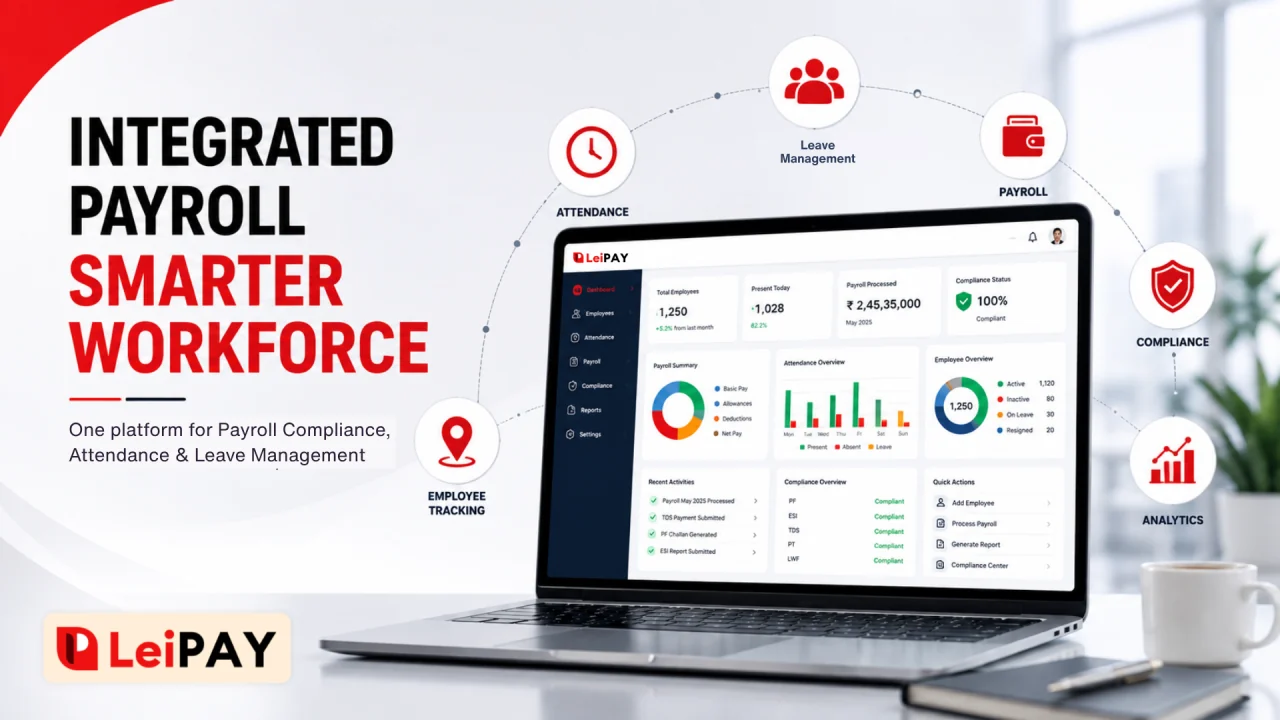
Managing today's workforce involves much more than calculating salaries. HR teams must coordinate employee records, attendance, leave, payroll, statutory compliance, approvals, and workforce data — often across multiple locations. When these processes are handled through disconnected systems or spreadsheets, errors increase, processes slow down, and HR teams spend valuable time on repetitive administrative work. This is where integrated payroll software makes a significant difference.
What Is Integrated Payroll Software?
Integrated payroll software brings key workforce processes together on a single platform. Instead of managing attendance, employee information, payroll, and compliance separately, organisations can connect these functions and create a more consistent flow of workforce data.
With an integrated solution such as LeiPay, businesses can streamline payroll and HR operations while improving visibility and control.
1. Connect Attendance Directly With Payroll
Attendance data has a direct impact on salary calculations. Manual attendance entry can result in incorrect working hours, missed overtime, leave discrepancies, and payroll adjustments.
Integrated payroll software connects attendance information with payroll processing, helping HR teams:
The result is a smoother transition from attendance tracking to salary processing.
2. Improve Employee Data Management
Employee information is often spread across multiple files and systems. An integrated platform creates a centralised employee database where HR teams can manage essential workforce information throughout the employee lifecycle.
From onboarding and employee records to payroll and workforce updates, centralised data helps reduce duplication and makes information easier to access.
3. Simplify Payroll Processing
Payroll teams deal with multiple salary components, deductions, allowances, attendance inputs, and employee changes every pay cycle. Integrated payroll software automates many repetitive payroll activities and helps HR teams process salaries with greater consistency. This can help organisations:
Instead of spending hours reconciling information from different sources, HR teams can focus more on strategic workforce activities.
4. Strengthen Payroll Compliance
Payroll compliance is another major responsibility for businesses. Managing statutory requirements manually can become complex, particularly when organisations have large workforces or multiple branches.
Integrated payroll platforms can help streamline compliance-related processes such as PF, ESI, TDS, PT, and LWF management, while maintaining relevant payroll records and reports. Better automation and centralised information can also make it easier for HR teams to prepare for audits and compliance reviews.
5. Manage Multi-Branch Payroll From One Platform
For organisations operating across multiple locations, payroll management can become even more challenging. Different branches may have different employee counts, attendance data, payroll inputs, and administrative requirements.
A centralised multi-branch payroll platform enables organisations to manage workforce and payroll information across multiple branches while maintaining centralised visibility. This helps HR and management gain a clearer picture of workforce operations without relying on disconnected spreadsheets.
6. Enable Smarter Attendance With Geo-Fencing
For organisations with field employees or distributed teams, traditional attendance methods may not provide enough visibility. GPS-based geo-fencing attendance can help organisations verify employee presence within authorised locations.
This can reduce unauthorised attendance practices and provide more reliable attendance data for payroll processing. When attendance and payroll are connected, verified workforce data can flow into the payroll process more efficiently.
7. Give Employees More Control
Modern workforce management is not only about helping HR teams. Employees also expect faster access to their payroll and HR information. Employee self-service capabilities can allow employees to access information such as:
Giving employees access to relevant information can reduce routine queries to HR and improve the overall employee experience.
8. Turn Workforce Data Into Business Insights
Integrated payroll systems can also transform payroll data into useful business insights. With centralised reports and analytics, management can monitor workforce trends, payroll costs, attendance patterns, and other important metrics.
This enables leaders to make more informed decisions about: Workforce planning → Payroll costs → Productivity → Employee management → Business growth
The Bigger Picture: From Payroll Processing to Workforce Management
The future of payroll is not simply about paying employees accurately and on time. It is about connecting payroll with the broader workforce ecosystem. When HR, attendance, payroll, compliance, and employee management work together on one platform, businesses can reduce administrative complexity and gain greater operational visibility.
Why Businesses Are Moving Toward Integrated Payroll Platforms
An integrated approach can help organisations:
Ready to Modernise Your Payroll and Workforce Management?
Explore LeiPay and discover how one platform can help simplify payroll, attendance, compliance, and employee management. LeiPay connects employee records, attendance and leave, statutory compliance, and multi-branch payroll into one intelligent workflow.
Also read: Still Struggling with Payroll? Let LeiPay Do the Heavy Lifting | Automated Attendance Management — The Key to Accurate Payroll and Better Compliance
Final Thoughts
As businesses become more distributed and workforce operations become increasingly complex, disconnected HR and payroll processes can create unnecessary challenges. Integrated payroll software provides a smarter way to connect people, processes, and payroll data.
By bringing HR, attendance, payroll, compliance, and workforce management together, organisations can spend less time managing administrative tasks and more time building productive, efficient, and scalable workplaces.
The future of workforce management is integrated — and it starts with smarter payroll. See LeiPay pricing or book a live demo to explore it for your organisation.