

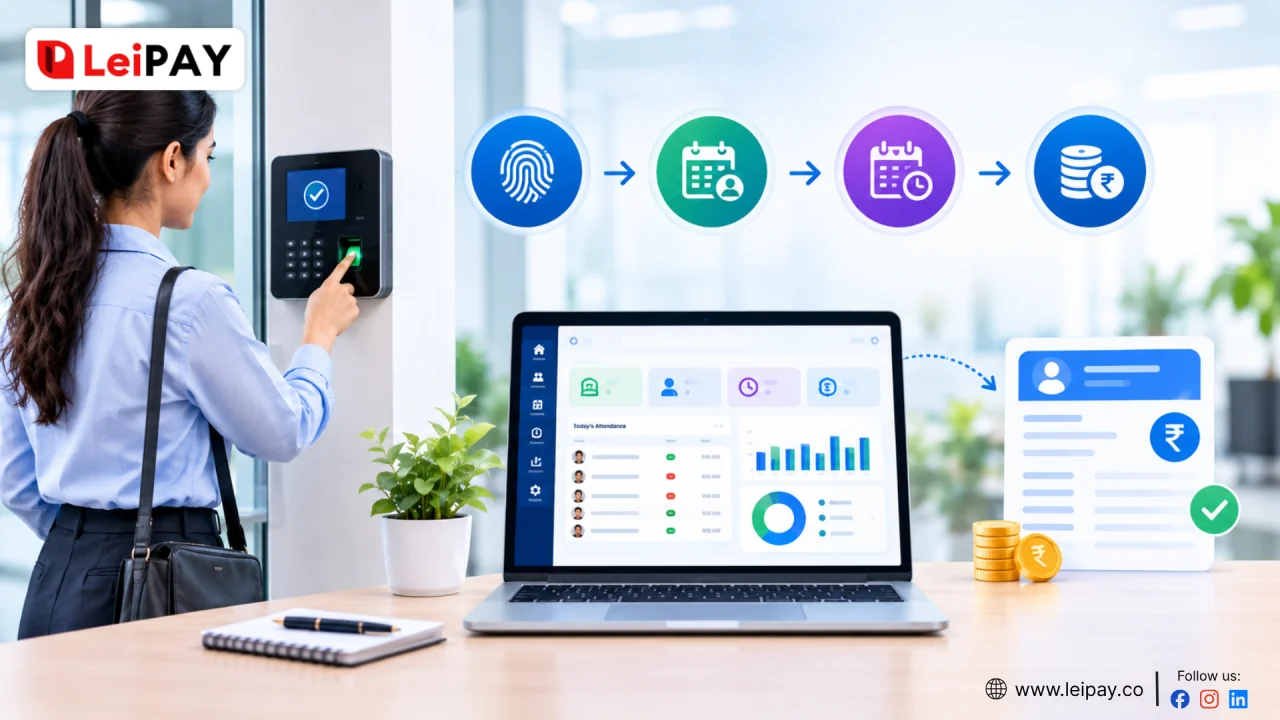
Payroll accuracy starts long before payday. Every employee punch-in, punch-out, late arrival, overtime hour, leave request, and loss-of-pay day can directly impact the final salary calculation. When attendance data is managed manually, HR teams often spend hours collecting information, checking spreadsheets, correcting errors, and transferring data into payroll. This is where attendance management software changes the game. By connecting attendance directly with payroll, businesses can automate the entire journey — from employee check-in to accurate salary processing.
The Hidden Connection Between Attendance and Payroll
Attendance isn't just about knowing who came to work. It can influence:
When these details are entered manually into payroll, even a small attendance error can result in an incorrect paycheck. An integrated attendance and payroll system eliminates this gap by allowing verified attendance information to flow directly into payroll calculations.
1. Automate Employee Attendance Tracking
Modern attendance management software allows employees to record attendance through multiple methods, including biometric devices, geo-fencing, mobile applications, and other configured methods. This gives organisations flexibility to manage employees working from offices, branches, remote locations, or field environments.
Instead of maintaining separate attendance registers and spreadsheets, HR teams can manage attendance information through a centralised system.
2. Turn Attendance Data into Accurate Payroll
One of the biggest advantages of integrated attendance management is the direct connection between attendance and payroll. Verified attendance data — including present days, half-days, LOP, overtime, and leave-related information — can flow directly into the payroll process. This means HR teams don't have to repeatedly copy attendance information from one system to another.
Less manual entry means fewer opportunities for payroll errors.
3. Automatically Calculate Overtime and LOP
Calculating overtime and loss-of-pay manually can be time-consuming, particularly for organisations with large workforces or complex shift structures. Attendance management software can automatically track:
Once these values are calculated according to configured attendance policies, they can be reflected in payroll automatically.
4. Connect Leave Management with Payroll
Leave management is another area where attendance and payroll intersect. Employees can submit leave requests online, managers can approve them through workflows, and leave balances can be updated automatically.
This creates a smoother process from leave request → approval → attendance update → payroll calculation. The result is less manual follow-up for HR and better visibility for employees and managers.
5. Support Different Shifts and Work Patterns
Not every organisation follows a simple 9-to-5 schedule. Businesses may have:
A modern attendance management system can accommodate different shift timings, attendance policies, grace periods, holidays, and branch-level rules while keeping information centralised.
6. Give HR Real-Time Workforce Visibility
Manual attendance registers don't provide instant visibility. With a centralised attendance platform, HR teams can quickly understand: Who is present? Who is late? Who is on leave? Who has worked overtime?
This visibility helps HR and managers respond faster instead of waiting for end-of-month attendance reports.
7. Make Payroll Processing Faster
Imagine the traditional process:
Attendance collection → Spreadsheet updates → Verification → Corrections → Payroll data entry → Reconciliation → Salary calculation
Now compare that with:
Employee Check-In → Automated Attendance → Verified Data → Payroll Sync → Salary Calculation
The second approach dramatically reduces repetitive administrative work and allows HR and finance teams to spend more time on strategic activities.
Why Businesses Are Moving Beyond Manual Attendance
Manual attendance management may work for a small workforce, but complexity increases as an organisation grows. More employees mean more attendance records, shifts, leave requests, overtime calculations, branches, and payroll adjustments.
An integrated attendance management system helps businesses scale without increasing administrative workload at the same pace.
How LeiPay Connects Attendance to Payroll
LeiPay brings attendance, leave management, and payroll together on a single platform. Its attendance capabilities support multiple attendance methods, shift management, leave workflows, overtime and LOP calculations, and direct attendance-to-payroll synchronisation.
Employees Mark Attendance → Attendance Is Verified → Leave & Overtime Are Calculated → Data Flows to Payroll → Salaries Are Processed
Works the Same Way Across Every Branch
Multi-branch payroll keeps this same verified-attendance-to-payroll flow consistent across every location.
Feeds Compliance the Same Verified Data
Payroll compliance calculations use the same attendance record HR already trusts — no separate reconciliation needed.
Also read: Attendance Says 24. Leave Says 1. Payroll Says 23. Which Number Should HR Trust? | Automated Attendance Management — The Key to Accurate Payroll and Better Compliance
The Bigger Picture: Attendance Is the Foundation of Accurate Payroll
Payroll automation isn't only about automating salary calculations. It starts with accurate employee data. When attendance, leave, overtime, and payroll work together, organisations can create a more reliable and efficient payroll process.
For HR teams, that means less spreadsheet work. For employees, it means greater confidence in their pay. For management, it means better workforce visibility. And for the organisation, it means a more scalable payroll operation.
Conclusion
The journey from punch-in to paycheck involves much more than recording attendance. Every attendance record can contribute to the accuracy of an employee's final salary. By automating attendance tracking and connecting it directly with payroll, businesses can reduce manual work, minimise errors, improve visibility, and accelerate payroll processing.
The future of payroll begins with smarter attendance management. Ready to connect attendance with payroll? See LeiPay pricing or book a live demo and see how your organisation can simplify attendance, leave, and payroll operations.