

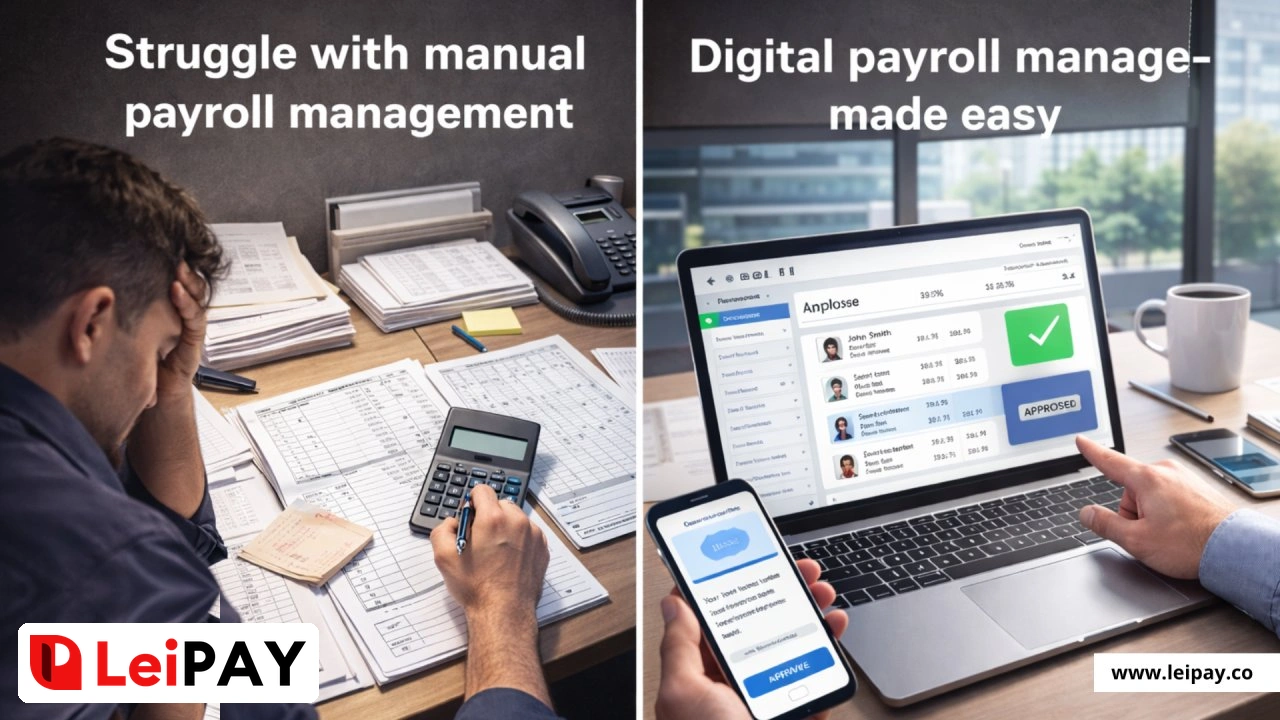
Payroll has always been a core business function — but the way it gets done has transformed completely. From handwritten ledgers and calculator-heavy HR teams to intelligent cloud platforms, payroll management software has evolved to meet the growing complexity of modern Indian businesses. Here is that journey — and where it is heading.
The Early Days — Manual Payroll Processing
For decades, payroll was entirely a paper-based exercise. HR and finance teams worked from employee registers, manually computed salary components, and filed statutory returns by hand. It was slow, error-prone, and invisible to management until something went wrong.
The core problems with manual payroll were predictable:
- High manual effort — every calculation done by hand, every month
- Calculation errors — wrong PF deductions, missed ESI contributions, incorrect TDS
- No visibility — management had no real-time view of payroll cost or headcount
- Compliance gaps — filing due dates missed, challans delayed, penalties incurred
As businesses grew, the limitations of manual payroll became impossible to ignore. A company with 20 employees might manage — but at 50, 100, or 500, the system collapsed under its own weight.
The first step in payroll evolution was not software — it was the recognition that manual processes cannot scale without breaking.
The Shift to Basic Digital Tools
The first wave of digitisation brought spreadsheets and basic accounting software into payroll. Calculations became faster, and some of the repetitive data entry was reduced. But these tools were not built for payroll — they were adapted for it.
The limitations were significant:
- Automated simple calculations but required constant manual updates for compliance changes
- No built-in statutory compliance — PF, ESI, and TDS had to be calculated externally
- No integration with attendance or HR systems — payroll data entered twice
- Version control was a problem — multiple spreadsheet versions led to conflicting data
Payroll became digital — but it was not yet truly efficient. The core bottleneck shifted from calculation to data management.
The Rise of Automated Payroll Systems
Purpose-built payroll software emerged to solve what spreadsheets could not. These systems understood salary structures, statutory rates, and compliance deadlines natively — and applied them automatically every payroll cycle.
The step-change improvements were immediate:
- Automated salary computation — earnings, allowances, deductions, and net pay calculated in seconds
- Built-in statutory compliance — PF, ESI, TDS, PT, and LWF computed automatically
- Faster processing cycles — payroll that took days now completed in hours
- Reduced manual intervention — errors dropped significantly, disputes became rare
This was the first time payroll could genuinely be called automated. The shift significantly improved accuracy and gave HR teams time back to focus on people rather than process.
Cloud-Based Payroll — A Game Changer for Indian Businesses
The move to cloud platforms was a turning point — not just for convenience, but for compliance. Indian payroll involves multiple states, multiple statutory bodies, and frequent regulatory updates. A cloud payroll system that automatically incorporates rate changes removes an entire category of compliance risk.
Cloud payroll unlocked capabilities that on-premise systems simply could not match:
- Secure, centralised data — payroll records accessible anywhere, backed up automatically
- Real-time reporting — salary cost, headcount, and compliance status visible instantly
- Scalability — add branches, employees, and locations without system changes
- Automatic compliance updates — new PT slabs, revised ESI thresholds applied without manual configuration
For multi-branch businesses across India, cloud payroll became the only practical option — managing different state rules, holiday calendars, and salary structures from one centralised platform.
Payroll Today — Integrated and Employee-Centric
Modern payroll management software has moved well beyond salary processing. Today, the expectation is a fully integrated system where attendance feeds payroll, compliance runs automatically, and employees manage their own payroll data through a self-service portal.
The defining features of today's payroll platform:
- Attendance and leave integration — working hours, overtime, and LOP feed directly into salary calculations
- Employee self-service portal — payslips, tax declarations, and Form 16 accessible on web and mobile
- Real-time dashboards and analytics — salary cost by department, compliance status, headcount trends
- Role-based data security — salary data visible only to authorised users, every action audit-logged
This integration eliminates the most common source of payroll errors — manual data transfer between systems. When geo-fencing attendance auto-logs a field employee's hours and those hours flow directly into payroll, there is no gap where errors can enter.
What's Next — The Future of Payroll Software
The next phase of payroll evolution is already visible in leading platforms. The shift is from automation to intelligence — payroll systems that not only process accurately but surface insights proactively.
Trends shaping the future of payroll in India:
- AI-driven payroll insights — anomaly detection, salary trend analysis, compliance risk flagging
- Advanced automation — complex payroll scenarios like project-based payroll and multi-currency handled automatically
- Mobile-first access — full payroll management from smartphone for HR managers and employees alike
- Deeper business integration — payroll data feeding finance, operations, and workforce planning systems
Why This Evolution Matters for Indian Businesses Today
Indian payroll has never been more complex — new Labour Codes, multi-state PT slabs, quarterly TDS returns, and increasing employee expectations for transparency. The businesses navigating this successfully are the ones that stopped treating payroll as a back-office process and started treating it as a business system.
Accuracy and Compliance
Modern payroll software eliminates manual errors and ensures PF, ESI, TDS, and Form 24Q are always computed correctly and filed on time. The penalty risk from late or incorrect filing disappears entirely.
Time and Cost Savings
What HR teams once spent 3-4 days on every month — collecting attendance, computing deductions, generating payslips, preparing challans — now completes in hours. That time returns to strategic HR work.
Better Employee Trust
Transparent payslips, instant access to salary history, and digital Form 16 through the self-service portal build the employee trust that manual payroll never could. Employees who understand their salary are employees who trust their employer.
Data-Driven Decisions
When payroll data is clean, connected, and real-time, finance and HR leadership can make headcount, budget, and compensation decisions with confidence — not gut instinct.
Final Thoughts
The evolution of payroll management software reflects the changing needs of modern businesses. What started as a manual process is now an intelligent, automated, and integrated system that supports growth and efficiency across the organisation.
For Indian businesses looking to scale with confidence — embracing modern payroll software is not just an upgrade. It is a business necessity.
LeiPay is built for exactly this stage of the payroll evolution — designed specifically for Indian statutory requirements, connected across attendance, compliance, and HR, and scalable from 10 employees to 10,000+.